PLAYERS
2OBJECT
To be the first player to get all of his pieces "home" and then off the board.SETUP
The board should be set up as shown.
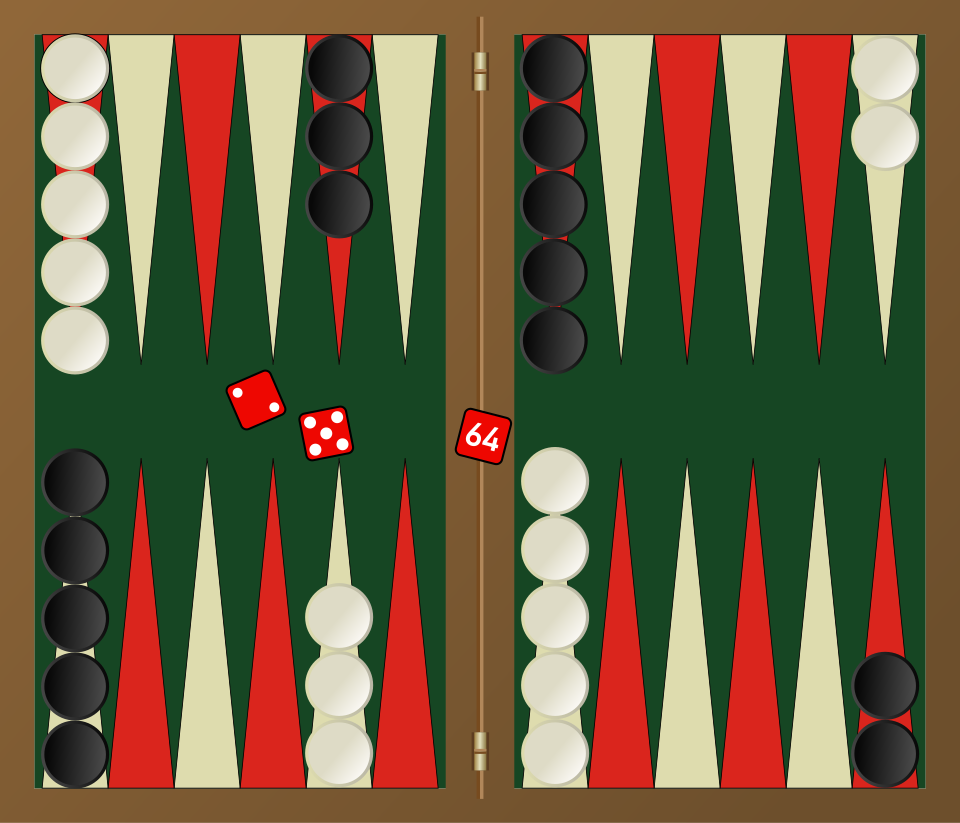
The numbers are for reference only. They illustrate White's journey-- from 1 to 24. White will have to move all her pieces into her home board (19-24) before she can begin to bear them off. Black will move in the opposite direction-- from 24 to 1.
So, to get all their pieces home:
- White moves to the left, up and across and to the right: 19 to 24 are her "home field."
- Black moves to the left, down and across, and to the right: 6 to 1 on this diagram are his "home field," though if we were counting from Black's side of the board, the numbers would appear reversed.
Each side of the board has a track of twelve adjacent points. The tracks make a continuous chain of twenty-four points, numbered from 1 to 24 in this case. Black's pieces will move from higher-numbered points to lower-numbered points; White's will do the opposite. The two players move their pieces in opposite directions, so the 1-point for one player is the 24-point for the other.
PLAY
Each player rolls one die. Whoever rolls higher plays the number on his own die and the number on his opponent's die as if he had rolled them both. After that, players alternate turns and roll both dice at the beginning of each turn.
After rolling the dice a player must, if possible, move his pieces the number of points showing on each die. On a roll of 6 and 3, for example, a player has to move one piece six points forward and another one three points forward. The dice can be played in either order, and the same piece can be moved twice, as long as the two moves are distinct and legal.
A player must play both dice, except in the following situations:
- If a player has no legal moves after rolling the dice, because all of the points he might move to are occupied by two or more enemy pieces, he forfeits his turn.
- If he has a legal move for one die only, he has to make that move and then forfeit the use of the other die for this turn.
- If he has a legal move for either die, but not both, he has to play the higher number.
If a player rolls two of the same number (doubles) he plays each die twice. For example, if he rolls two 5s he has to move four pieces forward five spaces each. (As before, a piece can be moved multiple times as long as the moves are distinct.)
A piece can land on any empty point or a point that's already occupied by pieces of its own color. It can't move to a point that's occupied by more than one enemy piece.
The Bar
However, if a piece lands on a point occupied by only one enemy piece, called a "blot," the enemy piece is taken off the board and placed on the bar, the divider between the two sides of the board.
A piece that's on the bar can only re-enter the game through the opponent's home field, depending on a roll of the dice. A roll of 1 allows it to enter on the opponent's first point, a roll of 2 on the second point, and so on. Of course, the points must either be empty, already occupied by pieces of its own color, or occupied by an enemy blot, which would then be sent to the bar itself.
A player with one or more pieces on the bar can't move any of his other pieces until all the pieces on the bar have re-entered the board.
Bearing Off
When all the player's pieces are in his home field (1-6 for Black, 19-24 for White), he can start removing them from the game, called "bearing off." A roll of 1 bears off a piece from the first point, a 2 from the second point, and so on. A number can't be used to bear off pieces from a lower point unless there are no pieces on any higher points. For example, a roll of 4 can move a piece on the fifth or sixth points closer to the first point-- but won't bear them off. A roll of 4 canbear off a piece on the fourth, third, second or first points.
SCORING
If a player has borne off some of his pieces by the time his opponent has borne off all of her fifteen, he loses a single game. If he hasn't borne off anypieces by the time his opponent has completely borne off, he has lost a gammon, which doubles what the game is worth-- either 2 points or twice the number on the doubling cube (see Gambling on Backgammon). If a player hasn't borne off any pieces, and still has pieces on the bar and/or in his opponent's home board by the time his opponent has borne off all fifteen, he has lost a backgammon, which counts for triple a normal loss.
Gambling on Backgammon
Some backgammon sets come with a six-sided die, called a "doubling cube," that bears the numbers 2, 4, 8, 16, 32, and 64. Players who gamble on backgammon games use it to double, that is, demand that the game be played for twice the current stakes. The doubling cube is placed ont he bar with the 2 side faceup to show that the game's value has been doubled. When challenged to a double, the opponent has to either accept the challenge or resign the game on the spot. After that, the right to redouble (double again) belongs exclusively to the player who last accepted a double. In this case, the cube is placed with the 4 faceup. The game is hardly ever redoubled above four times the original stake, but there's no theoretical limit to the number of doubles. Even though 64 is the highest number on the cube, the stakes can rise to 128, 256, and so on.